Monday, November 1, 2010

Prison or Pardon?

The Hook: The New York Times article “The Mississippi Pardons” by Bob Herbert is an editorial trying to persuade the reader that the release of Jamie and Gladys Scott from serving double life sentences in prison by Mississippi governor Haley Barbour is not only an act of compassion, but morally correct and absolutely necessary. The question is, are the rhetorical tools of ethos, pathos, and logos used in the article effective enough to convince the readers? You be the judge.

The Story: The sisters were said to have persuaded two men to go to a rural area outside of Forest, Mississippi, in 1993, where the men were robbed by three teenagers who Jamie and Gladys knew. A total of $11 dollars were taken and no one was harmed.

Why we care: Governor Barbour has already pardoned 5 men, all with charges of murder, from their life sentences. They had all previously been in a prison program that had allowed them to work at the Governor's mansion. If he's already pardoned these men, why not the two sisters??

Ethos:

  • The information in the article is not specific, with few direct quotes. This could lead to decreased credibility because of the ambiguous sources of information. Your average Joe might not care, but your average New York Times reader will. If the information isn't reliable, why should they be bothered to act on something that they may have been misinformed of?

  • However, the New York Times has also been described as a more liberal paper, so the readers might already have strong opinions for the sisters to be released because of the type of information they are used to seeing in the paper. This article was published for the purpose of gaining support from the liberal readers that are in favor of pardoning those who have been punished too harshly.

Pathos:

  • The first emotional appeal comes in the author's noting that one of the sisters, Jamie, is suffering severely from medial problems, specifically kidney failure. The sisters are saying that Jamie will most likely die in prison because of her health problems. This strikes a chord with the readers, because almost everyone knows someone with a horribly painful medical condition and knows the hardship that the situation puts you in. More people will want to root for the sisters' release because they want Jamie to have time to live before she dies.

  • Another well employed appeal to the emotions of the readers is the quote at the end of the article from the sisters' mother, saying, “I wish they would just hurry up and let them out. I hope that is where it is leading to. That would be the only justified thing to do.” Everyone has a mother or a mother-like figure in their lives that they respect and admire, a woman they would do anything for. By putting the mother's quote in the article, the author reaches into that sentimental pocket and pulls out a deep emotional connection that the readers feel, making them want to sympathize with the mother and help her get her children back.

  • The diction that the author uses makes his opinion clear, and also helps to persuade the reader that there is “only one real choice.” Phrases such as “unconscionable and grotesquely inhumane,” “unquestionably committed shockingly brutal crimes,” “dangerous abuses of executive power,” and “beyond disturbing” are examples of the type of writing the author uses to make his point. These words put the situation in a “black or white” light, displaying good and evil, with no gray in between. These make the reader feel like it is their moral responsibility to favor the sisters and support them however they can. Readers that do not immediately take the sisters' side might even be criticized as cruel and without a heart.

  • As I looked for more information on this case, I found that several articles used a quote from Benjamin Jealous, the president of the NAACP, that the author of this article chose not to include. Jealous said, “It is a travesty that in the state of Mississippi, the lives of two Black women are valued at little more than 11 dollars.” I think the author omitted this quote for a purpose. By taking out the racial part of the equation, the case is solely a moral argument, with no other factors, like race, that could taint the argument with misconceived prejudice and irrelevant hate.

Logos:

  • The juxtaposition of the sisters' double life sentence to the two year sentence of the teens who actually robbed the victims serves to further the author's point that the sentence placed upon the sisters is too severe and that it should be rescinded as soon as possible. In my opinion, the author is so against the sentence placed upon these sisters that he thinks that the governor should make the sisters homemade cookies and write an apology letter in addition to pardoning them.

  • Another appeal to logic is the governor's track record – he's already “...pardoned, granted clemency to, or suspended the sentences of at least five convicted murderers, four of whom killed their wives or girlfriends” (Slate.com). Why then would he have a problem releasing two middle-aged women who were only accomplices to the robbery? It also brings up a point of controversy that further weakens the governor: all the pardoned men had been in a program that allowed them to work in the governor's mansion in a prison trusty program prior to their pardons. This bit of information leaves us to wonder whether the governor pardoned them for legitimate reasons.

  • The way the information in the article is presented is a logical appeal in itself. After the first paragraph, the odds are already stacked in favor of the two sisters because the article has been set up in the best way possible to keep our interest and our opinion. The author reels in his readers by minimizing the involvement of the sisters and making the severity of their sentence seem nonsensical. He then gives the obvious “right choice” to pardon the sisters from their sentences, and finally fills in the details by using supporting information to back up his point while subtly attacking the opposing side of the situation. This grabs the reader from the start and doesn't let them go until they are thoroughly convinced of the author's opinion and make it their own opinion as well.


The Verdict:

The author did a great job using rhetorical appeals to convince his readers, and an even broader audience of average people, to side with the incarcerated sisters in their petition for a pardon. Despite the authors misuse of ethos in giving ambiguous information that could have possibly been detrimental, his use of pathos and logos more than made up for it. The emotional appeals of reader association and diction were used effectively to make the audience feel connected to the sisters and their plight. The logical appeals of organization and background information serve to satisfy the intellectual reader by bringing up new points proven by fact to help further the argument. I'd say the article is effective because, hey, I'm convinced.
Do You Believe in Love? Mormons Do.

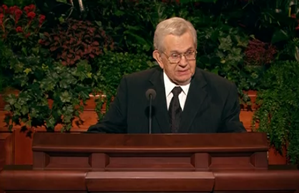
        Sex, politics, and religion are three topics that should not be discussed at the dinner table (or anywhere else for that matter.) It is very rare that one can express his or her opinion on one of these issues without accusations, disagreements, and plain misunderstanding from the opposing side. On October 4, 2010, the Human Rights Campaign (HRC) filed a petition including 150,000 signatures, which spoke out against a talk given by Elder Boyd K. Packer, a leader in The Church of Jesus Christ of Latter-day Saints. In his talk, Packer reinforced the Church’s viewpoint that marriage between a man and a woman is ordained of God. Although Packer intended for his words to inspire and remind Mormons to keep the commandments of God, many people misunderstood his intentions. His words were misinterpreted and many viewed his remarks as detrimental towards gays and lesbians.

        In the HRC petition, David Melson, Executive Director of Affirmation: Gay and Lesbian Mormons, said, "Elder Packer's remarks in General Conference were not only ill-advised and contrary to fact, but were mean-spirited and will be perceived by many as bullying. We see no potential for good coming from his words and much possible damage, to the Church, to individuals, and to families. The LDS Church should be a source of love, compassion, and conciliation, and not of fear and unfeeling petty hatred."

        Contrary to the Melson’s belief, the LDS Church is in fact a source of love and compassion. On October 12, 2010, Michael Otterson, a representative of The Church of Jesus Christ of Latter-day Saints, gave an address regarding the petition. Through his words, he successfully expressed the viewpoints of the Church and its’ position regarding the issue through a variety of rhetorical tactics. By focusing on love, using doctrinal references, and reaching a common ground between different groups in the audience, Otterson was able to deliver his address in an effective and successful manner.

Love.

        Otterson states that the doctrine of the Church of Jesus Christ of Latter-day Saints is based on love and this becomes an underlying theme in his address. True to the Faith, an informational resource book published by the LDS Church, reminds that we are all children of God. The world is full of many different types of people, but if we remember that we are all brothers and sisters, this realization can “transcend all boundaries of nation, creed, and color.”

        Because there are varying types of people, there are some who claim that they are attracted to the same sex and that those feelings were inborn. However, a key point to Otterson’s address is that there is a difference between having these feelings and acting upon them. Although the feelings may in fact be inborn, in the end, it is our decision whether or not we are going to act on those feelings and give in to temptation. Corinthians 10:13 says we will not be tempted more than we can handle. This means that even if someone is born with an attraction to the same sex then they are able to overcome these feelings. However, this is easier said than done. Otterson acknowledges this by saying, “There is no question that this is difficult, but Church leaders and members are available to help lift, support and encourage fellow members who wish to follow Church doctrine.” He emphasizes that although life is full of difficulties, the Church of Jesus Christ of Latter-day Saints is one to help others through these difficulties.

        Despite the strict viewpoints of the LDS Church, Otterson recognizes that everyone is able to make their own decisions and not everyone will choose to follow the Church’s established guidelines. By doing this, he recognizes that the Church’s standards won’t be accepted by all, yet the Church will be acceptant of all people. Jesus Christ, whom members of the Church believe in and follow teachings of, commanded everyone to love one another. Otterson reminds that this is one of the underlying concepts of the Church. Throughout the address, the example of Christ is brought up and the reminder that the LDS Church focuses on love is emphasized. Members of the Church of Jesus Christ of Latter-day Saints strive to show unconditional love towards all men despite their decisions. Many people think that Mormons aren’t accepting of people with different standards but Otterson rhetorically discredits this claim by focusing on love.

Doctrine.

        Throughout the address, Otterson establishes a ground of credibility that clearly gives justification for the words spoken by Elder Packer. He directly states the Church’s doctrinal belief which outlines to non-member’s why Mormons have the viewpoints that they do. He says, “As a church, our doctrinal position is clear: any sexual activity outside of marriage is wrong, and we define marriage as between a man and a woman.” These beliefs come from The Family: A Proclamation to the World. This proclamation given by leaders of the LDS Church blatantly says that marriage should be between a man and a woman. Members of the Church aren’t simply making up their own ideas of what’s “right”, they are following the words of counsel given by their prophets. This rhetorical strategy gives credibility to Otterson. Because he is a representative of the Church of Jesus Christ of Latter-day Saints, he is acting under the direction of the Church’s prophet and therefore the things he is saying are true.

Common Ground.

        Even though Otterson uses an abundance of religious references, he balances out his claims with mentioning the HRC as well. Because he is speaking to a wide audience, he is careful to appeal to each type of person. Otterson does a good job of staking a common ground between members of the LDS Church and the rest of the world, especially gays and lesbians. In his introductory remarks, he acknowledges that there have recently been “tragic deaths across the country as a result of bullying or intimidation of gay young men.” Although the Church does not agree with homosexuality, Otterson says that that should never be the cause of unkindness. The LDS Church does not support any level of cruelty “whether those differences arise from race, religion, mental challenges, social status, sexual orientation or for any other reason.” By making it clear that Mormons are accepting of all types of people, Otterson is able to get his point across in a more effective and all-encompassing manner. Instead of people simply being upset at the Mormons because they are Mormon, they can be more understanding that we have good intentions. After recognizing this, others can make a more educated stand on the viewpoints of the religion.

        In Michael Otterson’s address in regards to the HRC petition, many rhetorical tactics were used to get his point across. He acknowledged that not everyone will agree with the Church’s standpoint but states that “We (as a Church) hope that any disagreement will be based on a full understanding of our position and not on distortion or selective interpretation.” By accurately explaining the viewpoints of the Church while focusing on love, using a doctrinal approach, and reaching a common ground between the members of the audience, Otterson is successfully able to deliver his address and increase awareness of the issue at hand.

Turning a House into a Home


Spencer Tolson

Katherine Cowley

Writing 150 Honors: Writing and Rhetoric

2 November 2010

Turning a House into a Home

America is a land built upon foundations of hard work and the sacrifice many generations have made over the course of the nation’s history. It is a country proud of this history, which is filled with heroes and heroines that have changed many lives by their inspirational actions. Many of these heroes have arisen because an outside force required it of them so they and others could survive. They had to adapt to the situation. Great people can arise from the dust of catastrophe and hurt. The Great Depression, Pearl Harbor, and 9/11 are just a few examples of a crisis that produced heroes and in way that unified the American people behind a single banner. Throughout these catastrophes one powerful documenting technique has set itself apart from writing and reporting. That is, the power of photography. Photography had played a huge role in major events since the discovery of the camera. Mother of Seven, Rosenthal’s picture of the flag raising on Iwo Jima, and other pictures have had a change on the outcome of the crisis and influenced it for the better. However, a crisis has arisen in present that is hard to photograph. That is, the recession that America’s economy has suffered, and to some degree, still experiencing. Paul Reyes writes about this difficulty and the difference between the housing crisis and other crises. It is harder to capture images of a recession in where most of the heartbreak and anguish is happening in banks and on computer screens than it is to photograph homeless people on the street. However, there are opportunities for great inspirational photos for the attentive photographer. He focuses on one aspect that has shown some positive results in the photography section of reporting. It is that of the housing crisis. Paul Reyes is a writer for the New York Times. His means of getting his message across to the general public are about as good as it gets. His article speaks to such a large audience, printed for the entire nation through a prestigious paper. He does an excellent job of orienting the reader with how photographers have documented crisis in the past, such as the Great Depression, before going into his area of expertise. He cites historical examples of many photos and photographers that transformed photography into an art. He uses well known images and paints a vivid picture in the reader’s minds, a powerful picture that shows much more that what is on the paper. With that still fresh in the brain of the reader, he goes into the subject of his paper. That is, picturing the housing crisis.

The article then goes on to speak of how in times past, inspirational pictures have come from images of humans in an act of extreme bravery. This crisis is of a different nature. In this instance, inspirational pictures come from half completed houses and the empty ones. These pictures speak to the most basic nature of humanity. Ever since the beginning of time, home and safety have been a priority. In Maslow’s hierarchy of needs, home provides the first two needs: food and safety. Only then can the other needs and other levels be achieved. This need for a home base to recharge and regroup to go back in to the world is achieved with a house. The first thing a newlywed groom does is carry his bride over the threshold of their new home. Homes are associated with happiness and success. People put hundreds of thousands of dollars into homes, with features such as pools, king size beds, and walk in closets. In terms of financial spending, it is one of the most expensive investments that every person tries to make. In American society today, houses stand for much more than just a house. It represents family, security, a place of rest, and a place of relaxation. It almost goes against human nature to see an empty home. An empty shell of a home can mean so much more to a someone. Paul Reyes focuses on this. While this recession is not one of breadlines and gas lines, it is a recession that can speak just as powerfully as the Great Depression. Bare walls. Half finished homes- and dreams. This appeals to an emotional side of the reader. When thinking of what I want in my life, a house is near the top of the list. A house for my family, in which memories could be created and love can exist. I believe that this dream is a dream I share with many people my age, and even younger. I see the pictures and read the article and worry what is to become of me and my future family. This is what Paul Reyes is trying to do. His audience is the common American trying to make a living and a better place for himself, and the New York Times is well suited to carry it to every one of us. His tone is one of somberness, but of beauty. His purpose in writing is to find something beyond the empty homes, the holes in the wall, and the scratches on the table. Every person has a story, and every house has had a person. His article suggests that this theme of things being half completed impacts the reader more than a picture where everything seems to be explained. The viewer’s mind is left to wonder who walked through the doors of a foreclosed house. What kids played in the yard. How many memories that were made in that very room? Again, Paul Reyes is an excellent writer, in that he gets to the very heart of the reader. He talks of something that means so much to every reader of his article. They are forced to care. He forces the reader to understand that a house is so much more than a house.

He goes on and analyzes different photographer’s takes on the crisis. Some photographers focus on the house as a whole. Again, this can hit the reader in a way nothing else could. When first turning the corner of the street where my house is, my little sister exclaims with excitement. The image of our house is burnt into her mind as a place of refuge. As I went home this weekend, I could close my eyes and imagine the simple outline of my house and be content, knowing I would soon be home. Some photographers focus on little things in the house. The example is given in the article of an empty room with a lone lamp standing in the corner, or a plastic hanger lying on the carpet. These forgotten homes speak of forgotten dreams, rudely awakened by the harsh reality of the housing crisis. We are all just one bad stroke of luck away from being homeless. Paul Reyes’s article makes this reality become alive to me. The sequence of pictures is also very important too. Showing a shot of the outside of a house does not clue the reader into what is inside, while shots of the inside do not show the true framework of the house. Some shots are even arranged and set up to be the way the photographer wants. Whatever the case, all try to influence the viewer just as any movie or book would.

This crisis is tragic. As a college student, this article speaks to me in a way it could not to a child, or to a retired man. I am about to go into the professional world where I want to be successful. Success can be defined many different ways. For me, part of success is providing a decent home for my family to live together in. A place where they can feel safe and sound, and know there is love there. Obviously a house is essential to this plan.

link to my site

my site

Love Will Keep Us Together


On October 13, 2010 the Human Rights Commission delivered a petition with over
150, 000 signatures opposing the comments made by President Boyd K. Packer of The Church of Jesus Christ of Latter-day Saints in the recent October Semi-Annual General Conference. President Packer’s comments concerning gay marriage came at a sensitive time for many individuals, especially within the United States. The Church released a statement proclaiming their determination to not back down on their position but also expressing their love and respect for all individuals involved. By using love as the motivation for their message and an effective form of rhetoric, The Church of Jesus Christ of Latter-day Saints strove to portray themselves to the world not as a hateful body of anti-homosexuals but as a respectful, honorable and Christian organization.

Michael Otterson, managing director of Public Affairs for the LDS church, delivered the statement to a room of reporters. Dressed in a modest suit and tie, Otterson typified the type of individual whom the church wanted the world to associate with the LDS faith. Dignified and respected worldwide, Otterson expressed the church’s point of view with sincerity. The choice of Otterson as deliverer of the response to the HRC was a rhetorical move by church leadership, whether intended or not. Otterson has a reputation among the press of being fair and just in his judgments. Besides his position in the LDS church, Otterson is also the author of a blog published by the Washington Post. When Otterson stood to deliver the church’s message, the press viewed the statement in a new light. There stood one of their own, one whom they knew by reputation and, for many, personally. Besides the reputation of the church, Otterson’s reputation now backed the words he said.


The United States has recently been hit by an emerging wave of disturbing effects from anti-gay and anti-lesbian bullying. It has resulted in several suicides and pain for many individuals and their families. It was into this environment that

President Boyd K. Packer’s comments were broadcast, and many immediately tookoffense. Many interpreted his blunt and powerful remarks as insensitive and cruel. The LDS church opened their statement with an expression of sympathy and love towards all those who have suffered because of their sexual orientation. It is followed by words of condemnation for those who inflict pain upon anyone because of their differences.

Mormons are different. They have long “…felt the bitter sting of persecution and marginalization…when [they] were too few in numbers to adequately protect [themselves]”. LDS people have long felt the same type of suffering that many homosexuals feel. Isolation and loneliness, the victims of misconceptions and stereotypes, these are all things that Mormons have experienced. Love is again brought into play. Everyone has felt the deep connection that comes from shared experiences. By calling to attention these mutual experiences, the LDS church strives to find common ground with victims who have taken offense and help them see that they aren’t so different after all. With common ground, individuals are more willing to hear the words being said with an open mind.

At the same time, church leaders were addressing those members of the church who might have uncharitable feelings towards homosexuals. A common saying in Mormon culture is that the church is true, but the people sometimes aren’t. By making statements such as these, church leadership encourage Latter-day Saints everywhere to share the same stance, to not judge but to love.

After making appeals to the gay community, Otterson then uses the ultimate example of love and compassion, Jesus Christ, to appeal to Christians in general. Many Christians

believe that Mormons are going against the doctrine of Christ by speaking out against homosexuals and gay marriage. Many former Mormons, who left the church because of their sexual orientation, feel that the Church is being hateful towards them and therefore hypocritical in their own beliefs. Love again enters the rhetoric of the conversation. “Jesus Christ, whom we follow, was clear in His condemnation of sexual immorality, but never cruel…Each Latter-day Saint family and individual should carefully consider whether their attitudes and actions toward others properly reflect Jesus Christ’s second great commandment – to love one another.” While disagreeing with an individual’s actions, the goal of the LDS church is to continue to respect and love them. True Christ-like love is unconditional. While none of us is perfect, LDS leadership showed through their references to Christ that they are striving to keep his commandments.By clarifying their determination to love, the statement portrayed LDS to other Christians not as hypocrites but as disciples of Christ.

In response to the Human Rights Commission’s demands that The Church of Jesus Christ of Latter-day Saints retract the statement’s made by President Boyd. K, Packer, the church made it very clear that it was in no way backing down on its position or denying its beliefs and doctrine. The statement declares, “Any sexual activity outside of marriage is wrong, and we define marriage as between a man and a woman.” This stance has caused much negative publicity to arise concerning the LDS church in recent years. The vote that took place on the infamous Proposition 8 in California is one instance where homosexuals felt the church was attacking their lifestyle and their rights. Otterson, on behalf of the church, reminds those who harbor grudges against the Mormons that although they do not support gay marriage, they do support other rights for those who feel same-sex attraction. This was a rhetorical attempt to show individuals that not only does the church feel love for them, but it will also put that love into action when their rights are in danger. However, there are no apologies given for what the church has said and done in opposition of gay marriage, and there is no inclination shown to give any.

It may seem odd to look at refusal to apologize as an expression of love or rhetorical technique; however, it is an effective tool that is sometimes forgotten or overlooked. The individuals that we most respect in life are those that never back down. Many times, we admire people we disagree with personally because they are so strongly devoted to their cause. Respect is a form of love, and indeed as humans we tend to eventually love those we most respect. The firm statements given concerning the irreversible doctrine of the LDS church are meant to clearly explain the doctrine to the world in hopes that when understood, it will foster respect not resentment.

Many who signed the Human Rights Commission’s petition were in disagreement with Mormon doctrine. Ironically enough, just as many homosexuals are the victims of misconceptions, the LDS church is often cited for believing in doctrine that doesn’t actually exist. One purpose of the press release is obviously to clarify and define church doctrine officially and then respond with love. While explicitly stating that same-sex attraction is against church doctrine, the statement offers up ways that individuals who feel this attraction can still be active participants in the church and receive loving help and guidance from church leaders.

The final sentence of the LDS response sums up the entire outlook of church officials. "We hope and firmly believe that within this community, and in others, kindness, persuasion and goodwill can prevail." Kindness, persuasion and goodwill - all mean showing love. The Human Rights commission's petition was sent because individuals felt that the church was expressing feelings of hate. The purpose of the response was to assure these individuals that Mormons strive to feel only feelings of love towards the homosexual community. Love is said to overcome all boundaries, and there are times that no amount of rhetoric can replace what occurs because of love. The Church of Jesus Christ of Latter-day Saints' response to the HRC petition shows that love is indeed a form of rhetoric.


Ogres Are Like Onions!

Television newscasts have long been seen as a convenient, and accessible medium for the American public to stay informed and up –to-date. Trusted networks such as Fox and CNN deliver news stories that range from political updates to social phenomena. Most of these news sources choose to deliver their newscasts both on television and in an online digital format, allowing for greater ease of access and therefore increased exposure. The Onion, one such online news provider, enables its audience to experience a refreshing take on today’s current events in both print and video formats.

Recently, the Onion News Network (or ONN) featured a video entitled “Thousands of Girls Match Description of Missing Sorority Sister.” Presented in this video format, the story takes on a familiar feel, as the viewers take in a serious and professional reporter framed by a very realistic looking newsroom. Just as one would expect, a series of updates stream across the bottom of the screen, boasting such titles as “TYLER PERRY MARRIES HIMSELF DRESSED AS A WOMAN,“ “HAPPENING NOW IN SEATTLE: TERRIFIED SPIDER SCREAMS RIGHT BACK AT WOMAN,” and “BLACK & DECKER INTRODUCES PAPER SHREDDER SHREDDER FOR EXTREME PARANOIDS.”

The story addresses the difficulty facing the Columbus Police Department in finding a missing Ohio State University student. Jessica Hagan is described as a member of the Kappa Alpha Theta sorority who was last seen wearing “a tank top, Ugg boots, and blue Victoria Secret pajama pants with the word pink written across the back.” The report continues by noting that the police had received over 13,000 tips, all of which had led them to other students matching the exact same description. If there is one thing to be said about the Onion, they get to the point. The website is full of stories that are characterized by extraordinarily blunt messages, presented in manner that takes the opposing side, yet leaves no doubt about the real message.

Why isn't "phonetic" spelled the way it sounds?

By virtue of navigating to theonion.com, it is assumed that one will have a sense of humor, and will most likely be relatively young. College students would therefore be one subset of the target audience, and would almost certainly find a great deal of humor laced with undeniable truths in this video. While only artificial appeals to ethos, pathos, and logos are evident within the story itself, the result is one of real rhetorical influence on viewers. In quoting various “reliable” sources, the onion establishes an excess of logical appeals. One quote notes that the Columbus Police had come to the conclusion that they would release Jessica’s complete DNA sequence, as they had determined that “at a certain point, it literally becomes the only way to tell.”

It is fairly common knowledge that truly great humor stems from observations based on real life experiences and known truths. Seinfeld, a show about nothing, features the day-to-day lives and comedian Jerry Seinfeld and his friends. Many of Jerry’s most well-known quotes are simply well-said observations.


"I once had a leather jacket that got ruined in the rain. Why does moisture ruin leather? Aren't cows outside a lot of the time? When it's raining, do cows go up to the farmhouse, "Let us in! We're all wearing leather! Open the door! We're going to ruin the whole outfit here!"


Oftentimes, people find the most humor in observations such as these that they can link to real people or events. This video draws images of prom queens and sorority girls in the minds of viewers everywhere, and as a result presents a form of humor that transcends the general and becomes a comedic triumph on a very personal level. Everyone knows those girls, and everyone can appreciate the humor in the police descriptions of Jessica Hagan. After the initial list of Jessica’s attributes only led police to thousands of girls fitting the exact same description, they managed to create a list that further narrowed down the search, allowing police to sift through the multitudes of girls who turned themselves in thinking they might be Hagan. The new list is displayed on the screen and features things like “always ready to have fun but is also really organized,” “bedazzled iphone case,” and “describes herself as ‘such a dork.’” Just as the caption on the screen informs viewers that, “sightings place Jessica at hundreds of possible locations within 15 minutes of disappearance,” it is easy for people to think of multiple people that would easily fit Jessica’s descriptions

Hey, every joke has a kernel of truth.

At some point it is necessary to look deeper than the surface level humor, and uncover what this video really says about our culture and society. At best, this “news story” is an entertaining portrayal of the absurdity and one-dimensionality of today’s young women; at worst, a disturbing commentary on an increasing trend that represents the decay of female decency, maturity, and intellectuality. No matter how you choose to look at it, there is certainly something to be said for the accuracy of the story as a moral and societal commentary.

As if the overlying theme of a lack of identity for today’s young adults (“Jessica was last seen with OSU fraternity brother: either this man, this man, this man, this man... or this man”), the story subtly gets to the heart of another problem in our society- the decline of familial relationships. Although it plays a small part in the story, and would be easily missed by many, the caption that reads “Jessica’s Mother: ‘Please help us find Jen, I mean Jess,” speaks volumes. While an extreme example, this appeal to ethos invokes an initial response of laughter, followed soon after by the realization that, as with all things Onion, there is some measure of truth behind the humor. The statement by Jen, I mean Jess’s mother could be taken to mean a variety of things. Certainly it furthers the representation of Jessica Hagan as a girl without an identity - someone who no one can seem to recognize. In addition, however, it sheds light on the ignorance of parents with regards to their children’s whereabouts and goings-on.

Well, surely it's not what you do, but the, uh... the way that you do it.

The fact of the matter is that the Onion has taken audience awareness to a whole new level. The writers of these news stories know what it is their readers care about, what will make them laugh, what will make them think, and what will make them come begging for more. In their crusade to capture the hearts and funny bones of their audience, the Onion displays a mastery of rhetorical devices and strategies that allow for a greater level of success in the online world. Rich with irony, and satire, it is not a source to which one would go for an accurate and straightforward representation of current events. On the contrary, the Onion would most likely be the last place someone would look on such occasions. If, however, a reader were looking to experience and enjoy a fresh twist on social, political, and a variety of other issues, this would be an excellent source to seek out. It is not an easy thing to effectively deliver a message using blatant satire and sarcasm. In fact, it takes a considerable amount of rhetorical proficiency, and the Onion has proved their qualifications on this note time and time again.

The Core of Altruism

 In a world without religion or beliefs that assist us in judging our actions, things would develop in completely different ways; things quite simply would not even resemble their current state if we changed people’s beliefs from an earlier point. Also, actions like justice, agency, and even existence wouldn’t exist, so evaluating our ideas of religion, and our positions in morality become increasingly valuable and important. Assuming that God did create us, we are able to fill in many of the blanks that science has yet to understand, and speculative action towards areas that science may never explain are “revealed.” However, taking the non-theological understanding of the world, how would things play out? What would be the likely outcome of the evolution of man and the world? In an article titled "Morals Without God?" in the opinion section of the New York Times, Professor de Waal writes about all of these questions, and the relation of morality, evolution, and religion. Analyzing the text's strong evocations of ethos, pathos, and logos will be examined, as well as the ultimate reasons that the author's feelings will not appeal to the intended audience.

A Piece by Bosch
One of the first ideas that is introduced by the author in this text, is the depiction of the area that he grew up in, an author that lived there long before, and one of his paintings describing an idealistic existence inside of nature (how could art describe something otherwise?) This influence set into motion some of his initial interests regarding the topic of morality in nature, and appears as one of his first appeals in the establishment of ethos. Though he states that he isn’t an expert in the art of Bosch, he does call on this artistic piece with a hope that others might be able to understand or compare similar experiences to his own, and gain a model of perspective for a future application of his pathos or logos. 

Following his description of artistic influence in the development of his thought, he introduces a biological perspective to morality, which could definitely be considered his strongest appeal to the general audience, is the main point of the article, and is the author’s strongest use of logos. The discussion of a biological perspective in the understanding of morality gives a substantive way to measure whether something is or isn’t moral and gives us a strong appeal to logos. Studies of the prefrontal cortex and various primates with similarly structured brains have shown that actions generally considered as altruistic and human are programmed in animals also. However he doesn’t assume the probability difference of animals and humans exhibiting these characteristics, he makes a generalization that they will act similarly much of the time, but basic experience would indicate otherwise. Our ability to obtain a higher level of consciousness means greater reasoning capabilities and conclusions of action that are usually dramatically different than animals. This is a fundamental perspective that is not acknowledged by de Waal, but it’s likely that his analysis on this topic would follow the rest of the paper, and remain atheistic and naturalistic. This issue is partially addressed later in the paper, but nevertheless is an assumption that he holds on to, to a large degree.

A strong evocation of pathos occurs here also. The author proves he knows his audience by tossing in comments about religion, that are snippets directly contradicting the logical approach of biology, and tuning in to the more agnostic/atheist audience accustomed to reading articles of this sort. Some examples of this are proved when he mentions the comment by Reverend Al Sharpton, the one line comment about what would happen to Christianity in the abyss of evolution and especially the inevitable demise of Christian beliefs with the acceptance of ultimate factual ethos belonging to science. He says "Deep down, creationists realize they will never win factual arguments with science. This is why they have construed their own science-like universe, known as Intelligent Design, and eagerly jump on every tidbit of information that seems to go their way." His acknowledgement of these beliefs immediately grips the audience, no matter what side they are on, to read on and see what choice he will ultimately elucidate as prevailing. All the while the author is prancing on a topic—morality-- that is generally considered to be of central value in a person’s perception, thereby evoking strong emotion through his speculation regarding religion and the use of logic through biology.

One of the most powerful phrases from this opinion paper comes when the author partially rebuts Reverend Sharpton’s comment that without God there is no morality. De Waal says “Perhaps it is just me, but I am wary of anyone whose belief system is the only thing standing between them and repulsive behavior.” This is a comment that I’m sure all of us agree with; we certainly hope that there is something inherent in nature that disallows us to fall prey to our “worse” side and exhibit harmful behaviors. I strongly dislike approaching things from a strongly theological perspective, but from an Latter-Day Saint perspective this inherently smacks of the “Light of Christ” arguments we believe about human nature. This shows another—completely unintended-- appeal to the logos of what is probably the minority in the audience, the Latter-Day Saint grouping and definitely helps to establish some of his credibility and ethos among these select few readers.
In the next section de Waal looks into some empirical examples in studies that he has done or observed, to strengthen his view, as well as some short but fairly succinct analysis of the notion of pleasure in influencing altruistic action. The citation of behavior exhibited by the animals in his empirical examples is really strong, and gives a strong appeal to his ethos, but also the logos of the text. The fact that the author has conducted experiments to prove his point, and the experiments have produced the expected results, shows he has the capacity to look for external variables that could influence a view like the one that he holds, and proves that his point is tenable from a logical perspective with observations that can be proved many times over, with different animals, and completely different environments and social groups.

The view that morality evolved from social instincts in the evolutionary progression of nature is used to make his point appeal to both the religious man, and the scientist. The author tries to tell the religious man that his actions have not been contradictory to the nature of things, and in this action perhaps reduces the pain of any “toes that have been stepped on” by his biologically determined bulldozer. At the same time, he tries to prove that his point is legitimate from a logical perspective by showing examples of animals acting extremely altruistic.

The religious perspective often sees
morality without God as inherently
self-absorbed.
He continues in the text to argue that the evolution of nature, specifically the nature of primates, is to try to create a greater amount of fairness and equality, specifically this perspective is an example of logos. He cites examples of primates helping each other, and even finding joy in helping their fellow animals. It is at this point that he reflects a tone of passion, he states “I am a firm believer in the Humean position that reason is the slave of the passions.” He uses this as an assumption in his assertion that altruism is biological, and although it is an interesting point, he leaves himself susceptible to a reduction of logos due to the difficult time he would have in proving this point completely, like he indicates he believes. Also, the firmness of his position in this belief and the emotion that he has toward this topic is partly revealed at this point, and reflects an example of pathos.

The final portion of this opinion page was likely to leave the assumed main audience – the scientific atheist – slightly bewildered by an unpredictable ending. De Waal concludes the essay with the final assertion that science has no authority in the determination of morality and the determination of action. He also concedes a major point, and says that inevitably people will fall prey to the western culture, and are steeped in the Christian morality that accompanies it. This argument is very interesting in comparison to the rest of the paper, because he concedes that the biological arguments that are cited to prove why altruistic morality is good actually don’t matter. The scientific crowd reading this is really left with no option but to embrace the Christian morality, even though they might not believe that it’s true. The author continues along this train of thought and even says that even if we could get rid of organized religion and replace it with science, religion would inevitable make a comeback in issues of a speculative nature. This tone lacks the optimism of most mainstream atheists and agnostics.

In conclusion, the option of participating in social politics that reflect the Christian altruism and beliefs is, according to de Waal, inevitable despite the commonly held belief in the scientific community that God doesn’t live. The author seems to establish really strong ethos among the scientific readers, using strong logic as an connection to pathos, but the “Atheist Dilemma” section of the text seems to dash a viable alternative to Christian morality, and leaves the reader with a question. If the God doesn’t live, what underlying force or physiological process motivates actions that aren’t calculably selfish?

Picturing the Crisis: Rhetorical Analysis

Everyday Rhetoric

Rhetoric is found everywhere, whether it be on a billboard, in a literary text, or even on a grocery store advertisement. It’s used every day in the form of speech: in arguments, in conversations with a friend, in stories told around a campfire, in texting or TV commercials, in an appeal to a parent for the use of the family car. Rhetoric is what convinces an audience to agree with the speaker or writer.

It is vital in establishing credibility as well. Rhetoric helps a reader understand where the writer wants to go with their opinion and how to get to that point of understanding. Along with that, rhetoric is used to describe a point of view and offer solutions in how to solve the issue.

So What?

In Picturing the Crisis, an online commentary from the New York Times, the writer Paul Reyes establishes rhetoric through the emotions, or pathos, and also with ethos by posting stirring photos, recalling significant memories from United States history, and providing interesting commentary that shows the reader how foreclosures are an increasing problem in American society and need to be addressed.

The Effect of Images

In Picturing the Crisis, pictures and visuals are really what set the tone and bring the meaning to life. The very first thing that is brought to the reader’s attention when first opening the article is a picture of a kitchen. At first glance, it’s just a kitchen. There is no significance or meaning. Reyes generally asks, “…would the images resonate the same way without knowing beforehand that you were looking at a foreclosed home? Probably not."


However, the first lines states, “One of the ways we remember an economic crisis is through images." Immediately, the reader stops and re-evaluates the image. What’s the significance with the photo now? They notice that the kitchen is empty. There are no furnishings, no food, no people, and no color. The cupboards are open, the refrigerator is out of place, and the floor is filthy. Only then does the reader begin to realize what’s going on. Things start to connect in a way that wasn’t as apparent before. Reyes is definitely using ethos through the use of visuals and the descriptions connected to them. He knows that they will catch some attention.

Throughout the rest of the document, there are links posted (underlined and highlighted in blue). Not only do those attract attention all by themselves, but when clicked on, they come up with more images that support the author’s theme. These include Migrant Mother by Dorothea Lange, Now Let us Praise Famous Men by Walker Evans, Fort Myers and Detroit by Bruce Gilden, and Anthony Suau’s Cleveland. Now, even more artists from different genres are covering foreclosures in America and bringing them to the surface in order to help citizens understand the effects. He’s taken recent artists and pinpointed their work in one common place.


It’s the connection between these pieces that creates such an overwhelming feeling of seriousness. It’s not just one person’s focus. Many people are beginning to make this the focus of their work. They see it as a serious problem as well and want to make it more known to the general public. “And while it remains to be seen if it achieves the social and artistic impact of the Depression-era work, foreclosure photography has already helped define an era that will mark American society for decades to come." By including these images in his writing and bringing them all together in one place, Reyes applies to the visual senses of the reader which in turn makes things more realistic and understandable.

Emotional Appeals

Not only does Capturing the Crisis use images to capture attention, but it adds compelling emotional appeals as well. Great events are mentioned throughout the writing: The Great Depression, Wall Street problems, Dow plunges, the oil crisis of the 1970’s, (and more recently) the Great Recession, September 11th, and Hurricane Katrina. Each name has a powerful significance, but none have a positive connotation associated with them. They were each a time of hurt and depression in our history. Many homes were lost and lives affected.


Depression and Foreclosure: a Growing Epidemic


People died as a result of all of these tragedies. During the Great Depression, people lost their jobs so they weren’t able to afford proper food, clothing, housing, or schooling. The Depression, along with the Wall Street problems and the plunge of the Dow, led to, essentially, depression! Many people couldn’t handle the situations they had been thrust into and found suicide a welcome alternative to the pain they felt in their situations. This had a great impact on big and small communities alike. As the more recent crises have occurred, many families have found themselves in the center of economic downturn once again. This essentially leads to a foreclosure on their homes. The past seems to repeat itself, and this is no exception.

As an impact of depression, foreclosure is a major issue facing our nation right now. New stories are posted in the news daily, and even more go unnoticed. Foreclosure can mean different things to different people, however. For some, it is just a bad word—something to avoid at all costs. For others, it’s a house being abandoned, belongings being repossessed, cardboard boxes, constant worry and tears.

Depression and foreclosure are still major problems here in the United States. Reyes sees this is as a key recurring issue in our society, and he wants to bring some light on the situation in order to inform readers of the recurring harmful trend. He wants this trend to stop and for people to find hope! For this reason, he’s brought all these elements together and given foreclosures a new outlook.


Digging a Bit Deeper

In the mixture of all the rhetoric through pictures and events, Reyes uses interesting and compelling commentary to add the final touches to his argument. For example, he includes comments like this:

“But in viewing foreclosure interiors, a curious thing happens: the voyeuristic awkwardness passes, and one begins to piece together the missing characters. We already know the circumstances, generally; but why was a wallet-sized snapshot of children left behind? What left the holes in the wall? Through these questions that flit behind the scanning eye, the portraits become a kind of forensic study."

The reader is here left to think for him or herself. This is the take-home message, or the point where the reader really has to start forming an opinion of the issue. It's the point at which the issue becomes more real and compelling, and one asks, "What can be done to help this situation?" The author applied this technique by simply asking a question that digs a bit deeper than the surface.


The Take-Home Message


A viewer is able to connect to a piece of writing through elements of ethos, all of which were presented in Paul Reyes’ Picturing the Crisis. He sums up the point of his rhetoric with this final message: “In a single image it’s difficult to illustrate the size and enormity of the problem [of foreclosures]. But they all come from the same idea, and the result is the same in the end.”

Packer's Promise

Jacob Bagley

Kathy Cowley

Writing 150

10/30/2010

Packer’s Promise

The Church recently made an official statement on the controversial talk by President Boyd K. Packer where he said, now famously, "why would God do that to anyone?" The statement was cool, reasonable, and had a strong emphasis on the fact that we have love for everyone, but cannot accept homosexuality in any form. Essentially, what this statement is, truly is, is the collected statement of a Church who holds to what the world would call “old-fashioned” beliefs, but refuses to leave them. It is our statement of why we stand for what we stand for, but not in a tone of mockery, but in a light of love.

Recent events have critically damaged much of what we as a church stand for; our inability to accept what is "new" has pegged us as old fashioned and outdated. What we stand for is the family, the happy home with loving parents who rear children

Homosexuality makes this impossible, and President Packer's controversial statement about our inability to accept it has once again made waves in the national arena. Almost immediately after it aired gay rights activists were demanding a retraction and proclaiming it as incorrect and false. The response to this then was a statement of our beliefs and our steadfastness in our love of everyone; as well as our denial of homosexuality as a lifestyle.

This is a very pertinent and “Hot Button” issue for many people in this day and age. I do not wish to offend anyone, but our Church, and the Church of Christ has always been against Homosexuality in all forms, and it will remain so because: 1. It mocks the plan our Heavenly Father has for us here on Earth, to learn of him, to become married to a member of the opposite sex for the purpose of creating children. 2. This life style is not conducive to the happiness of another person but is based upon selfish lusts and desires.

From an analytical standpoint, the opening three paragraphs are very mellow. Instead of focusing on our right to have an opinion, the church response shows how we are similar, not different. “While we disagree with the Human Rights Campaign on many fundamentals, we also share some common ground,” reads the article. The Church makes it very clear right from the beginning that we in no way seek to belittle or even encourage belittling and that we also share in the pain from the tragic death of gay teens. Rhetorically, this is essential for their argument, because we as a Church can only claim to be Christian if we hold to Christ’s code. We can condemn the sin, but not the sinners. Also, as the Church provides placating comments that seek to show similarities, it opens the possibility for greater acceptance and a wider audience as people will not be repulsed by off the bat claims of hellfire and damnation. You can see in the way terms of family, Jesus Christ, and love are brought up that they seek to create a softer image for the Church as opposed to the harsh opponents we are often cast as.

After the soft introduction, however, the Church wastes no time saying exactly what President Packer meant when he gave his talk: we do not accept homosexuality as a way for people to live, and we condemn the practice. This strong statement sets the tone for the rest of the article, laying out our design to restate Church doctrine. The strong statement of: “our doctrinal position is clear: any sexual activity outside of marriage is wrong, and we define marriage as between a man and a woman.” Clear, well defined, and to the point; but not without reasons. The Church states clearly that is a doctrinal teaching, but then follows up with the claim that “ultimately, we are free to act for ourselves,” re-emphasizing our belief in agency. They also define places where we have sided with Gays and Lesbians in favor of their civil rights. Rights to property and employment. The Church uses these historic instances as evidence of our tolerance and ability to side with people opposed to us under circumstances that we also deem as incorrect. This evidence provides a strong example as to why they can make our claims in a spirit of love and tolerance; they can do so because they have proven they have the ability to remain firm and tolerant in the face of things they may or may not agree with. This consistency and the statement thereof provides powerful proof for their arguments.

Pictured: President Monson, LDS Prophet, sits in council with other church leaders

The closing theme for the statement is based upon the fact that the Church recognizes there are members of their society who struggle with these things, and that the Church offers them a spirit of hope and love. They speak about Heavenly Father’s eternal purpose to recognize the fulfillment and joy of all of his children, and speak about the need we have to love one another and grow closer together as a community. The purpose behind closing with a sense of unity can no doubt be to emphasize the need to draw strength from one another through these trying times, and to hold to what brings communities together. These statements make it hard to cast Church officials in a bad light, when they speak out for individual Church rights and the drawing closer together of those of the church and in the national community as well. These messages of tolerance, belief, faith, and integrity show that the church is not a mindless or ignorant discriminatory body but instead a firm foundation committed to ideals in the Latter Days.

These statements have the potential to be very offensive, but I want to say that we as a church do not judge or discriminate against these people either. As stated in Agency, we believe all men have a choice to live as they desire. We love these people and pray for their return to righteousness, and we befriend them and serve them as we can. I believe people of different views can disagree and still be friends; this is the foundation of our government in America, our melting pot. I stand absolutely behind every word in this article; I would never judge another person as “wicked” or “evil”. Judgment is reserved for those who have committed no sin, and I have committed sin, so therefore I cannot judge. I believe that it stems from pornography, which is the greatest evil of our age. I fight against pornography in all forms for the degradation and total abuse of these beautiful children of God used in such despicable and evil ways for the monetary gain of another.

Photo: Michael Otterson Delivers Address